Friday, March 24, 2006

YEAH! ME TOO!

SPEAKING TRUTH TO POWER: THE WHOLE SORDID PROLOGUE

Here's another book I've begun after recently finishing The Ancestor's Tale and Kate Remembered. Also I'm reading in The Handbook of Evolutionary Psychology, a fine book that supports a lot of my claims that we're all just a bunch of sophisticated robots, but just now, I'm scanning you the entire prologue to a book called Blinded By the Right, written by David Brock. Maybe you remember him. He's the young man who was seduced by the conservatives while in Berkeley and who began to work for them until the lying, the cheating, the ruination of careers that conservatives called on him to do, shook him back to his idealistic, youthful roots. I think he now heads up an outfit called Media Matters. Returned to his good senses, he has written this book. I hope he got rich in the doing of it. I hope you'll look it up in your local library and give it a thorough read or, better yet, buy a copy and read it.

[Open quote.] This is a terrible book. It is about lies told and reputations ruined. It is about what the conservative movement did, and what I did, as we plotted in the shadows, disregarded the law, and abused power to win even greater power.

My story is about those familiar corrupting influences of ambition, greed, and ego. It is about how human weakness, lack of confidence, and emotional discomposure can lead to a susceptibility to manipulation for bad ends. It is also about the dangers of zeal and extremism in a political cause, and about how one can be blinded to the ethics of one's own actions.

I came to Washington in 1986 as a conservative rebel from Berkeley, California, and from that moment through the latter part of the l990s, as the leading right-wing scandal reporter, I was a witness to, and a participant in, all of the scandals that gripped the capital city—Iran-Contra, the failed nominatiOn of Robert Bork to the Supreme Court, the Thomas-Hill hearings, Troopergate, Paula Jones, Whitewater, and the secret scheming that led to the impeachment of President Clinton. The conservative culture I thrived in was characterized by corrosive partisanship, visceral hatreds, and unfathomable hypocrisy. I worked for leading institutions of the conservative movement—the Washington Times, the Heritage Foundation, and the American Spectator—where I fought on the wrong side of an ideological and cultural war that divided our country and poisoned our politics.

The process of breaking ranks from a tight-knit political movement has been slow and torturous. The break came not in one decisive moment, but in a series of revelations great and small, about the character and actions of those who were my friends, about my own character and actions, and ultimately about the fanatical cause behind it all. There were times when I was not sure I would live through it to tell this story.

In the 1940s and 1950s, ex-Communist intellectuals created a literary genre documenting their break with Communism. In the 1970s and 1980s, so many liberals became conservatives that a new movement— neoconservatism—was born. Few have traveled in my direction, from conservatism to liberalism, at least publicly. It is the nature of an ideological defection such as mine to be a lone voice, met by denials or silence from my ex-comrades. Only they and I really know what we did and why we did it.

Though I do not know if these wrongs can ever be righted, in this or any other way, I wrote this book as an act of conscience, to correct the public record on events in which I played a central role and to illuminate for others the dangers that I see in an empowered conservative movement. How a man won a Supreme Court seat that I later learned he should never have won, how a lavishly funded campaign of political terrorism and propaganda disabled a presidency—these are events that may seem to perhaps everyone but me as if they happened a lifetime ago. But the wounds on the body politic from this era are still open. In the course of events that I describe in this book, the bad guys often won and justice was not always done. Many of the same forces, and many of the same players, still exert influence—a payback scheme in which old misdeeds are now being rewarded.

Twice as I tried to put this book to press, I was interrupted with official inquiries into the activities of my former associates. Several months ago, Theodore Olson, perhaps the top Republican lawyer in the country and the man who successfully argued the Bush v. Gore case for the Bush forces that won Bush the election, was nominated to be solicitor general of the United States. During his Senate confirmation hearing, Olson denied involvement in the American Spectator's Arkansas Project, a $2.4-million dirt digging operation against the Clintons funded by right-wing billionaire Richard Mellon Scaife. As a four year veteran of the Spectator, I was contacted by the Judiciary committee, and I described what I knew firsthand about Olson's integral role in the project, contradicting his sworn testimony.

While working on Blinded By the Right for the past three years, I stayed out of the news and used the time to attempt to find a sense of peace, emotional balance, and personal integrity that had eluded me during my dozen years in the right wing. I had no plan or desire to speak against Olson's nomination; I was simply answering questions. But when I did, failed Supreme Court nominee Robert Bork and former independent counsel Kenneth Starr fanned out in the press to vouch for Olson's character, and the virulent right-wing scandal machine, which my own reporting for the Spectator had done much to create back in the early 1990s, went into overdrive to besmirch me. Internet gossip Matt Drudge put up his flashing red sirens and claimed breathlessly that he had obtained a bootlegged copy of this book: "Brock Plans Scorched Earth; Book Outlines Reporter's Rise and Fall in Washington; Threatens Lawsuit Against Drudge." The trouble with Drudge's item was that he didn't have the book.

My last book, a biography of Hillary Rodham Clinton published in 1996, had been widely expected to be as vicious as my first book, my 1993 expose on Anita Hill, The Real Anita Hill. [By the way—this book is some more about the scorching attack on Anita Hill that conservatives got themselves up to.] When the Hillary book, The Seduction of Hillary Rodham, turned out not to be vicious, the right wing was enraged. Now, prompted by my statements about Olson, Norah Vincent, who had been an editor at the publishing house that brought out Seduction, wrote on the Los Angeles Times op-ed page, "If the world ended tomorrow and good and evil fought it out for keeps, I imagine that David Brock would be one of the devil's chief recruits." Lucianne Goldberg, the sometime literary agent and chief provocateur of the Monica Lewinsky scandal, called me a "turncoat twinkie" and suggested that the right wing had blackmail photographs of me.

If the senators believed my account, then Olson was seen to have given false and misleading testimony under oath. Despite my own checkered past, forty-seven Democratic senators voted against Olson based primarily on my eyewitness report. He was narrowly confirmed.

Such is the world I live in.

In August 2001, the Los Angeles Times called, looking for information on another Bush nominee, Terry Wooten, who had been tapped as a federal district judge. While writing The Real Anita Hill in the early 1990s, I searched for the confidential FBI file of Angela Wright, a damaging witness who said she was harassed by Clarence Thomas but never testified, in an effort to smear and discredit her. Wooten, the Republican chief counsel, gave me the file. I gave an interview to the Times about Wooten's illegal leaking, and I filed an affidavit with the Judiciary committee swearing to what had happened. When Wooten appeared before the Judiciary committee for his Senate confirmation in August 2001, he flatly denied giving me the FBI file. One of us had committed perjury.

A few weeks later, in late September, I sat across my dining room table from two FBI agents who interviewed me about Wooten and the Wright FBI file. I told them everything I knew about that tawdry episode. The FBI investigation concluded that while I had obtained confidential FBI material, the evidence against Wooten was not definitive, and Wooten was eventually confirmed. Yet regardless of the outcome, I was a witness to these events, and, as in the case of Olson, I believe there is something salutary to be gained simply by speaking and writing about them honestly.

With the security threats to the nation, which were years in the making, now so painfully obvious, a decade's worth of scandalmongering by the right appears all the more outrageously disgraceful. As the tragedy ushered in a new appreciation of the role of government, the government-hating project of the radical right seemed to suffer a tremendous setback. Yet there was no denying that even in a grave national crisis, some on the hard right did not for a moment suspend their dedication to a zealously intolerant, hate-filled, religious-based ideology.

It was sickening to see conservative commentator Ann Coulter call on America to "invade their countries, kill their leaders, and convert them to Christianity"; or to hear the Reverends Jerry Falwell and Pat Robertson blame the terrorist attacks on people who are pro-choice, gay and lesbian, or members of the American Civil Liberties Union; or to learn that conservative writer Michael Ledeen had pinned the death of Barbara Olson, a conservative pundit who perished, tragically, during the attack on the Pentagon, on the feminist establishment; or to read on the Wall Street Journal editorial page an opportunistic recommendation that the Bush administration use the crisis to push through another tax cut and confirm right-wing judges.

The need to shine light on the operations and agenda of the right wing has not abated in the wake of September 11. My intention is that the following political testament, offered in a spirit of both full disclosure and reconciliation, will serve as a cautionary tale of lessons learned the hard way. Even from the depths of depravity and desolation, a conversion of politics, morals, and ultimately of spirit is possible.

Washington, D.C. November 1, 2001 [Close quote.]

Wednesday, March 22, 2006

ONE LAST QUESTION OF DAWKINS
UNTIL THE NEXT BOOK

"When I give public lectures I always try to answer questions at the end. The commonest question by far is, 'What might humans evolve into next?' My interlocutor always seems touchingly to imagine it is a fresh and original question, and my heart sinks every time. For it is a question that any prudent evolutionist will evade. You cannot, in detail, forecast the future evolution of any species, except to say that statistically the great majority of species have gone extinct. But although we cannot forecast the future of any species, say, 20 million years hence, we can forecast the general range of ecological types that will be around. There will be herbivores and carnivores, grazers and browsers, meat eaters, fish eaters and insect eaters. These dietary forecasts themselves presuppose that in 20 million years there will still be foods corresponding to the definitions. Browsers presuppose the continued existence of trees. Insectivores presuppose insects, or anyway small, leggy invertebrates—doodoos, to employ that useful technical term from Africa. Within each category, herbivores, carnivores and so on, there will be a range of sizes. There will be runners, fliers, swimmers, climbers and burrowers. The species won't be exactly the same as the ones we see today, or the parallel ones that evolved in Australia or South America, or the dinosaur equivalents, or the mammal-like reptile equivalents. But there will be a similar range of types, making their livings in a similar range of ways." —Richard Dawkins, THE ANCESTOR'S TALE, p. 586


DID THE SYSTEM WIN?

I remember a long time ago, in the thick of the revolution, when an ad exec (I don't recall his name or who he worked for) said that the hippies could never win because they (advertisers) would always be there to turn everything into a commercial. I think that's what Albert Brooks is trying to get at in the following two paragraphs. Albert Brooks is the actor director who made the films, "Mothers", "Broadcast News", and "Defending Your Life", among many others:

"It's not that we didn't try. We did. We actually had the system by the throat for a whole minute. But the system won. The system doesn't get tired, or get arrested, or have screaming children who need things. The system is patient. It held up houses and cars and boats and we said, 'We don't need that!' And the system said, 'I'll wait. And while I'm waiting I might even get bigger, just for the fun of it.' And damn it, when the drugs wore off and the love wasn't free anymore, those houses and cars started to look good.

"I was feeling OK about us, I really was, that is until Madison Avenue stepped in and told me the truth. Aging is like going through a funnel. You start out with so much room, spinning so fast, wondering just how far you can go, but in the end you wind up going through that hole. That little hole. And since you can't take it with you, Kaiser Permanente wants it. I just wish Bob Dylan had held out a bit longer. I don't think Kaiser deserved that song. I think he should have saved 'The Times They Are A-Changin' for Depends.' " —Albert Brooks in a NEWSWEEK article, p. 60

Monday, March 20, 2006

DAWKINS GRINDS VERY SMALL INDEED

The following short passage demonstrates yet again Dawkins way of seeing the very small as the basis for so much large scale morphological change. Following him on his pilgrimage, we have arrived at life very small, but the passage below occurs only at Concestor Number 29 (the Placozoans) which rendezvous is—he's still nine Concestors away from the origin of life.

"This idea of community, as made up of lower-level units that flourish in the presence of each other, pervades life. Even within the single cell, the principle applies. Most animal cells house communities of bacteria so comprehensively integrated into the smooth working of the cell that their bacterial origins have only recently become understood. Mitochondria, once free-living bacteria, are as essential to the workings of our cells as our cells are to them. Their genes have flourished in the presence of ours, as ours have flourished in the presence of theirs. Plant cells by themselves are incapable of photosynthesis. That chemical wizardry is performed by guest workers, originally bacteria and now relabeled chloroplasts. Plant eaters, such as ruminants and termites, are themselves largely incapable of digesting cellulose. But they are good at finding and chewing plants (see the Mixotrich's Tale). The gap in the market offered by their plant-filled guts is exploited by symbiotic micro-organisms that possess the biochemical expertise necessary to digest plant material efficiently. Creatures with complementary skills flourish in each other's presence.

"What I want to add to that familiar point is that the process is mirrored at the level of every species' 'own' genes. The entire genome of a polar bear or a penguin, of a caiman or a guanaco, is an ecological community of genes that flourish in each other's presence. The immediate arena of this flourishing is the interior of an individual's cells. But the long-term arena is the gene pool of the species. Given sexual reproduction, the gene pool is the habitat of every gene as it is recopied and recombined down the generations."


KEEP YOUR EYES ON THE REAL MEN IN THE WAR

Army Captain Ian Fishback, having returned from Iraq, is courageous enough to give the lie to his superiors, Donald “Rumdumb” Rumsfeld and George “Bush-league” Bush. Isn’t that Rumsfeld’s nickname, “Rumdumb” or “Rummy” or some other nickname which suggests a penchant for alcoholic excesses like the late Senator McCarthy suffered from?

Captain Fishback claims, according to an article in Newsweek, (November 7, 2005), that torture is a systematic and approved practice in Iraq. He himself participated in it. Meanwhile, Bush threatens to veto any bill which has anti-torture language in it while winking a claim that the US does not approve of any forms of torture. McCain, really a Democrat at heart in so many ways, has this to say about torture: “This isn’t about who they are. It’s about who we are. These are the values that distinguish us from our enemies.” A liberal couldn’t have put it better and liberals have been saying such things from day one.


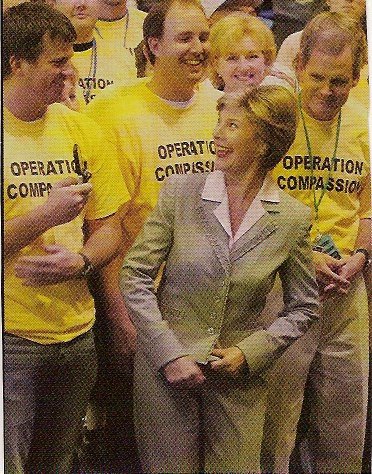
LAURA DANCES WHILE HUSTON BURNS


This was Laura Bush as she cheer-led Katrina rescuers. Can’t you just hear her as she says, “Yes, by golly gee whiz, that’s the way to go, kids!” Happier days in the past as dutiful spouse makes political capital for her lyin’ man.

A recent Newsweek article reports that Huston is no longer glad that they took in 150,000 Katrina survivers. Crime's up, welfare costs up, and medical facilities swamped—the infrastructure strained to the max.

Where's the money to rebuild New Orleans, boss? Could it be in Iraq, in the coffers of Haliburton?

Friday, March 17, 2006

INTELLIGENT DESIGN QUASHED AGAIN

By goodness, I'm getting close to the end of Dawkin's THE ANCESTOR'S TALE, very close. At the root of the debate below is an organic being called the bacterial flagellar motor which has a rotor mechanism in it. Dawkins shows in another place why larger animals could not evolve a wheel because the blood vessels and neural mechanism would twist themselves into knots as their wheel turns while the world turns. Then he goes on in the passage below to tickle out the reasoning which goes into his conclusions and to debate the clueless IDers who are always looking for things which could not have evolved so that they can say a supernatural power had to be involved in their appearance in the natural world. Wheeeew!

[Open quote.] As it happens, the bacterial flagellar motor itself has recently, in the hands of a species of creationists who call themselves 'Intelligent Design Theorists' been elevated to the status of icon of alleged unevolvability. Since it manifestly exists, the conclusion of their argument is different. Whereas I proposed unevolvability as an explanation for why large animals like mammals don't grow wheels, creationists have seized upon the bacterial flagellar wheel as something that cannot exist and yet does—so it must have come about by supernatural means!

This is the ancient 'Argument from Design', also called the 'Argument from Paley's Watchmaker', or the 'Argument from Irreducible Complexity'. I have less kindly called it the 'Argument from Personal Incredulity' because it always has the form: 'I personally cannot imagine a natural sequence of events whereby X could have come about. Therefore it must have come about by supernatural means. 'Time and again scientists have retorted that if you make this argument, it says less about nature than about the poverty of your imagination. The 'Argument from Personal Incredulity' would lead us to invoke the supernatural every time we see a good conjuror whose tricks we cannot fathom.

It is perfectly legitimate to propose the argument from irreducible complexity as a possible explanation for the lack of something that doesn't exist, as I did for the absence of wheeled mammals. That is very different from evading the scientist's responsibility to explain something that does exist, such as wheeled bacteria. Nevertheless, to be fair, it is possible to imagine validly using some version of the argument from design, or the argument from irreducible complexity. Future visitors from outer space, who mount archaeological digs of our planet, will surely find ways to distinguish designed machines such as planes and microphones, from evolved machines such as bat wings and ears. It is an interesting exercise to think about how they will make the distinction. They may face some tricky judgments in the messy overlap between natural evolution and human design. If the alien scientists can study living specimens, not just archaeological relics, what will they make of fragile, highly strung racehorses and greyhounds, of snuffling bulldogs who can scarcely breathe and can't be born without Caesarian assistance, of blear-eyed Pekinese baby surrogates, of waLking udders such as Friesian cows, walking rashers such as Landrace pigs, or walking woolly jumpers such as Merino sheep? Molecular machines—nanotechnology—crafted for human benefit on the same scale as the bacterial flagellar motor, may pose the alien scientists even harder problems.

Francis Crick, no less, has speculated semi-seriously in Life Itself that bacteria might not have originated on this planet but been seeded from elsewhere. In Crick's fantasy, they were sent in the nose-cone of a rocket by alien beings, who wanted to propagate their form of life, but shrank from the technically harder problem of transporting themselves and relied, instead, upon natural evolution to finish the job once the bacterial infection had taken root. Crick, and his colleague Leslie Orgel, who originally suggested the idea with him, supposed that the bacteria had originally evolved by natural processes on the home planet, but they could equally, while in the mood for science fiction, have added a touch of nanotechnological artifice to the mix, perhaps a molecular gearwheel like the flagellar motor which we see in Rhizobium and many other bacteria.

Crick himself—whether with regret or relief it is hard to say—finds little good evidence to support his own theory of Directed Panspermia. But the hinterland between science and science fiction constitutes a useful mental gymnasium in which to wrestle with a genuinely important question. Given that the illusion of design conjured by Darwinian natural selection is so breathtakingly powerful, how do we, in practice, distinguish its products from deliberately designed artifacts? Another great molecular biologist, Jacques Monod, began his Chance and Necessity in similar terms. Could there be genuinely persuasive examples of irreducible complexity in nature: complex organisation made of many parts, the loss of any one of which would be fatal to the whole? If so, might this suggest genuine design by a superior intelligence, say from an older and more highly evolved civilisation on another planet?

It is possible that an example of such a thing might eventually be discovered. But the bacterial flagellar motor, alas, is not it. Like so many previous allegations of irreducible complexity, from the eye on, the bacterial flagellum turns out to be eminently reducible. Kenneth Miller of Brown University deals with the whole question in a tour de force of dear exposition. As Miller shows, the allegation that the component parts of the flagellar motor have no other functions is simply false. [Close quote.]

Wednesday, March 15, 2006

BIRDS OF A FEATHER FLOCK. . .

Yes, that picture which looks so much like a bird is a dinosaur. The picture at the top is of the fossil itself. I did a little survey of the articles that Google gave me when I asked for "dinosaur birds", and I'd be dishonest if I didn't say that the debate as to whether birds evolved from dinosaurs is still very much heated.

But, speaking of fossils and ancient behavior, read below of the Nixonite-like behavior of the Bushites.


FROM THE INTERNET

Like Nixon, Bush and company have an enemies list. They never change, do they? I got the following info off the internet, but I can’t recall the exact address, so I’m lost to pass it on. Sorry.

[Open quote] Spurred by paranoia and aided by the USA Patriot Act, the Bush Administration has compiled dossiers on more than 10,000 Americans it considers political enemies and uses those files to wage war on those who disagree with its policies.

The enemies list dates back to Bush's days as governor of Texas and can be accessed by senior administration officials in an instant for use in campaigns to discredit those who speak out against administration policies or acts of the President.

The computerized files include intimate personal details on members of Congress; high-ranking local, state and federal officials; prominent media figures and ordinary citizens who may, at one time or another, spoken out against the President or Administration.

Capitol Hill Blue has spoken with a number of current and former administration officials who acknowledge existence of the enemies list only under a guarantee of confidentiality. Those who have seen the list say it is far more extensive than Richard Nixon's famous enemies list of Watergate fame or Bill Clintons dossiers on political enemies.

How is that you think Karl (Rove) and Scooter (Libby) were able to disseminate so much information on Joe Wilson and his wife, says one White House aide. They didn't have that information by accident. They had it because they have files on those who might hurt them.

White House insiders tell a disturbing tales of invasion of privacy, abuse of government power and use of expanded authority under the USA Patriot Act to dig into the personal lives of anyone the administration deems an enemy of the state.

Those on the list include former Ambassador Joseph Wilson and his wife, former covert CIA operative Valarie Plame, along with filmmaker and administration critic Michael Moore, Senators like California's Barbara Boxer, media figures like liberal writer Joe Conason and left-wing bloggers like Markos Zniga (the Daily Kos).

If you want to know who's sleeping with whom, who drinks too much or has a fondness for nose candy, this is the place to find it, says another White House aide. Karl (Rove) operates under the rule that if you fuck with us, we’ll fuck you over.

Rove started the list while Bush served as governor of Texas, compiling information on various political enemies in the state and leaking damaging information on opponents to friends in the press. The list grew during Bush's first run for President in 2000 but the names multiplied rapidly after the terrorist attacks of 2001 and passage of the USA Patriot Act. Using the powers under the act, Rove expanded the list to more than 10,000 names, utilizing the FBI's national security letters to gather private and intimate details on American citizens.

National security letters, which can be issued by an FBI supervisor without a judges review or approval, allows the bureau to sweep up the records of virtually any American citizen, examining their telephone calls, correspondence and financial lives of ordinary Americans.

The FBI issues some 30,000 national security letters a year to employers, credit bureaus, banks, travel agencies and other sources of information on American citizens. The Patriot Act also forbids anyone receiving such a letter to reveal they have passed on information to the federal government.

Those letters helped us build files quickly on those we needed to know more about, says a former White House aide.

The database of political enemies of the Bush administration is not maintained on White House computers and is located on a privately-owned computer offsite, but can be accessed remotely by a select list of senior aides, including Rove. The offsite location allowed the database to escape detection by special prosecutor Patrick Fitzgerald during his investigation of the Valerie Plame leak. The database is funded by private donations from Bush political backers and does not appear on the White House budget or Federal Election Commission campaign reports.

Bush is not the first President to use the FBI to keep track of his enemies. Richard M. Nixon used FBI files to try and discredit his opponents, including Daniel Ellsberg, the Department of Defense employee who leaked the Pentagon Papers to The New York Times. Bill Clinton used the FBI to compile dossiers on critics like Conservative Congressman Bob Barr and legal gadfly Larry Klayman of Judicial Watch.

But worried White House insiders say the intelligence gathered by the Bush administration is far larger, more extensive and potentially more damaging than the excesses of previous occupants of the White House. Even worse, it dovetails into a pattern of spying on Americans that has become commonplace since Bush took office.

Were talking about Big Brother at its most extreme, says one White House staffer. We know things about people that their spouses don't know and, if it becomes politically expedient, we will make sure the rest of the world knows.

The White House press official did not respond to a request for an interview on this story and did not return phone calls seeking comment. [Close quote]

Monday, March 13, 2006

SOME BEAUTY ON AN OFF DAY FROM INTERVIEW MAGAZINE

I'll tell you what my kick with this image is. Sitting here in the conservative heart of Washington State, the Inland Empire it's sometime called, it gives me a little kick of pleasure to send out a fashion image I got from a New York magazine, founded, I believe, by Andy Warhol. If he didn't found it, he had a hand in starting it up. Full of fashion and celebrity interviews, it's about as frolicsome and frivolous as a magazine can be. Even I can tell, now that I'm 68 years old, that what movie stars and celebrities say, can sometimes be a bit surreal. Even to me, it sounds something of a pose, like what's expected rather than what's real. And, then, they're such vulnerable targets for the conservative mugwomps, who like to slash and burn them!

I pity these stars for what their audience expects from them. How can they escape the toils of the consumer world when, after all, their personnae are items for sale just like a car or a conservative politician, so they have a pose and the media work off that pose, and so they are coopted by the world their characters' personnae fight against.

And, no, Abraham Lincoln could not be elected in modern America!

It's not that someone like George Clooney doesn't have something real to say, but when they say it in the glare of lights, outside the various characters they play, with all their millions glittering in clothes and jewelry, they can't compete with the characters they play which are more real than they are, so they come out lifesize and their words are reduced to the real world and thus what they say sounds tinny and unreal, like a poorly edited and shot film.
BOROWITZ REPORT IN OUR LOCAL INLANDER

You've probably all read some of Andy Borowitz's great work at satirizing current events. Included at the end of a recent satire about Bush debating Gena Davis from the TV drama, "Commander in Chief", Borowitz added, "Federal Reserve Chief Alan Greenspan said that he would step down in 2006, saying that he wanted to spend more time making indecipherable remarks to his family."


A LETTER I WROTE TO US NEWS AND WORLD REPORT
IN RESPONSE TO JOHN LEO'S LAUGHING ATTACK ON ATHLETES
GETTING CAUGHT USING STEROIDS

Subject: John Leo
Date: Thursday, August11, 2005 8:38 PM
From: George Thomas
To: US NEWS AND WORLD REPORT

Dear Editor,

John’s column was a hoot, but he misses a couple of points. I don’t believe it’s too far a bridge to say that part of the reason athletes and others in many fields of endeavor cheat is because America has made a chemical addiction to success a synaptical habit in the American psyche and has made being a “loser” something of a curse. We’re way overboard in accreting adrenaline toward success, money and power in this country.

Second, I hope John Leo, if he’s going to write as he does about human responsibility, has been doing some serious research in evolutionary biology. A great deal of evidence is piling up which shows that human traits such as lying, perseverance, aggressiveness, passivity, goal orientation, in fact just about any human trait which individuals pride themselves on or curse themselves for not having, are pretty much a matter of genetics, even the “gumption” by which one might find the personal resources to overcome or develop a trait (i.e. synaptical chemical habit) which he or she does or does not have seems to be genetic.

I’d suggest Leo read the book, The Illusion of Free Will, and catch up on some of the works of Daniel Dennett or Steven Pinker. He might also glance into The Origin of Minds by Peggy La Cerra for a good read on the mechanisms of memory and choice. He’d get some good insight if he’d read Going Inside: a tour around a moment of consciousness and learn just how “consciousness”, whatever that might be, functions within the human brain.

Sad to say, there just may not be as much free will in the Cosmos as some would like to hope. For example, just how much choice is involved in the angry moment of release when someone in a barroom brawl swings just hard enough to turn a moment of anger into a moment of murder? And in a rush of angry, fearful adrenaline, why can one man stop his trigger finger while another can’t stop it? I don’t think there’s very much moral choice in such moments which turn one human animal into a murderer while the other escapes that curse. Real objective study would help all of us to the truth rather than just our throwing around our emotions encapsulated in moral pejoratives.

Thanks a whole hell of a lot,

Geo

[Crazy as this may sound, I do believe that the more each of us admits to our being nearly robots when it comes to behavior the freer each of us paradoxically becomes. The truth literally can set us free in this regard.] This bracketed info was not included in the letter, damn it. I fired it off too fast.

Friday, March 10, 2006

MITOCHONDRIA WERE ONCE FREE-LIVING ORGANISMS

Three of these entries, including this one and not counting the time piece, are starting to get us to the very bottom of evolution now:

"Most significantly, we [the oak and humans] both use precisely the same code for translating nucleic acid information into protein information, as do virtually all the other creatures on the planet,*" writes Sagan, but in a footnote he adds a very interesting piece of information.

[Footnote] "*The genetic code turns out to be not quite identical in all parts of all organisms on the Earth. At least a few cases are known where the transcription from DNA information into protein information in a mitochondrion employs a different code book from that used by the genes in the nucleus of the very same cell. This points to a long evolutionary separation of the genetic codes of mitochondria and nuclei, and is consistent with the idea that mitochondria were once free-living organisms, incorporated into the cell in a symbiotic relationship billions of years ago. The development and emerging sophistication of that symbiosis is, incidentally, one answer to the question of what evolution was doing between the origin of the cell and the proliferation of many-celled organisms in the Cambrian explosion." (COSMOS, Sagan, p. 38)


GET YOUR MIND AROUND THIS AND AROUND AND AROUND

As for me, I didn’t know keeping time was quite this complex. I just look at the clock hands in the clock face on the wall.

"Average Earth time, officially known as TDB (for barycentric dynamic time, using French word order) is the astronomers' time scale. It is the time that would be kept by a hypothetical cesium clock at sea level on a fictitious Earth that swings around the Sun at a constant speed in a perfect circle, in an otherwise empty Solar System. (The arcane world of precision timekeeping is populated by nearly as many hypothetical clocks as real ones!) This time scale is obtained by correcting real clock readings for the seasonal variation, plus a smaller correction for the effect of the Moon on the Earth's motion." —Robert March in an essay "Does Anybody Know The Right Time?" in the collection of science writing called MYSTERIES OF LIFE AND THE UNIVERSE edited by William Shore


WE'RE ALL SPONGERS

We're getting down to sponges now, we're getting to the bottom of things. I've been plowing through this book for the longest time, but still to go are 100 more pages. I'm taking a lot of time to work on my algebra class also. Contemplate what Dawkins calls "landmark".

"The evolution of multicellular sponges from single-celled protozoa is one of the landmark events in evolution. . . ." Dawkins, THE ANCESTOR'S TALE, p. 486


HATE TO TELL YOU THIS, BUT NOT ONLY HAVE WE BEEN SPONGES,
WE'RE ALSO ALL ASSHOLES AT ONE TIME OR ANOTHER

"Gastrulation is something that all animals do early in their life. Typically, before gastrulation, an animal embryo consists of a hollow ball of cells, the blastula, whose wall is one cell thick. During gastrulation the ball indents to form a cup with two layers. The opening of the cup closes in to form a small hole called the blastopore. Almost all animal embryos go through this stage, which presumably means it is a very ancient feature indeed. You might expect that so fundamental an opening would become one of the two deep holes in the body, and you'd be right. But now comes the big divide in the animal kingdom, between the Deuterostomia (every pilgrim who arrived before Rendezvous 26, including us) and the Protostomia (the huge throng who are now joining at Rendezvous 26).

"In deuterostome embryology, the eventual fate of the blastopore is to become the anus (or at least the anus develops close to the blastopore). The mouth appears later as a separate perforation at the other end of the gut. The protostomes do it differently: in some, the blastopore becomes the mouth, and the anus appears later; in others, the blastopore is a slit that subsequently zippers up in the middle, with the mouth at one end and the anus at the other. Protostome means 'mouth first'. Deuterostome means 'mouth second'.

"This traditional embryological classification of the animal kingdom has been upheld by modern molecular data. There are indeed two main kinds of animal, the deuterostomes (our lot) and the protostomes (them over there)." —Richard Dawkins, THE ANCESTOR'S TALE, pp. 377-378

Wednesday, March 08, 2006

BACK IN BUSINESS

Got the old iMac back last night and now we're back in business.


JUST ANOTHER INTERESTING TALE

I found this tale about jellyfish on Mercherchar of the Palau Islands. Americans fought a pretty tough battle in those islands during the Second World War, I believe.

[Open quote] During the Second World War, sonar operators looking for submarines were puzzled by what seemed to be a false bottom of the sea that rose towards the surface every evening, and sank back down again the next morning. It turned out to be the bulk of the plankton, millions of tiny crustaceans and other creatures, rising to feed near the surface at night, then sinking at morning. Why should they do this? The best guess seems to be that during the hours of daylight they are vulnerable to visually hunting predators such as fish and squids, so they seek the dark safety of the depths by day. Why, then, come to the surface at night, for it is a long journey that must consume a lot of energy? One student of the plankton has compared it to a human daily walking 25 miles each way, just to get breakfast.

The reason for visiting the surface is that food ultimately comes from the sun, via plants. The surface layers of the sea are unbroken green prairies, with microscopic single-celled algae in the role of waving grass. The surface is where the food ultimately is, and that is where the grazers, and those that feed on the grazers, and those that in turn feed on them, must be. But if it is safe to be there only by night because of visually hunting predators, a diurnal migration is exactly what the grazers and their small predators must undertake. And apparently they do. The 'prairie' itself doesn't migrate. If there were any sense in doing so, it should swim against the animal tide, for its whole raison' d'ĂȘtre is to catch sunlight at the surface during the day, and avoid being eaten.

Whatever the reason, most of the animals in the plankton migrate down for the day and up for the night. The jellyfish, or many of them, follow the herds, like lions and hyenas tracking the wildebeest across the Mara and Serengeti plains. Although, unlike lions and hyenas, jellyfish don't target individual prey, even blindly trailing tentacles will benefit by following the herds, and this is one of the reasons jellyfish swim. Some species increase their catch rate by zigzagging about, again not individually targeting prey, but increasing the area swept by those tentacles with their batteries of lethal harpoons. Others just migrate up and down.

A different kind of migration has been described for the massed jellyfish of 'Jellyfish Lake' on Mercherchar, one of the Palau Islands (an American colony in the western Pacific). The lake, which communicates underground with the sea and is therefore salty, is named after its huge population of jellyfish. There are several kinds, but the dominant one is Mastigias, an estimated 20 million of them in a lake 2.5 kilometres long and 1.5 kilometres wide. All the jellyfish spend the night near the western end of the lake. When the sun rises in the east, they all swim straight towards it and therefore the eastern end of the lake. They stop before they reach the shore, for an interestingly simple reason. The trees fringing the shore cast a deep shadow, cutting off so much of the sun's light that the jellyfish's sun-seeking automatic pilot starts to drive them towards the now brighter west. As soon as they come out from the trees' shadow, however, they turn east again.

This internal conflict traps them around the line of the shadow, with the consequence (which I dare not think is more than coincidence) of keeping them a safe distance from the dangerously predatory sea anemones that line the shore itself. In the afternoon, the jellyfish follow the sun back to the western end of the lake, where the whole armada again becomes trapped at the shadow line of the trees. When it becomes dark, they swim vertically up and down at the western end of the lake, until the dawn sun lures their automatic guidance system back towards the east. I don't know what they might gain from this remarkable twice-daily migration The published explanation satisfies me too little to bear repetition For now, the lesson of the tale must be that the living world offers much that we don't yet understand, and that is exciting in itself. [Close quote] —Dawkins, THE ANCESTOR’S TALE, pp. 468-469
______________________________________________

“Men never do evil so completely and cheerfully as when they do it from religious conviction.” —Blaise Pascal (See, it’s not only us modern atheists who think this is true.)

Friday, March 03, 2006

FOUNDING FATHERS NOT CHRISTIANS

We've finally got proof that America's founding fathers were not Christians—at least they were not the same kind of Christians as our modern fundamentalists. In Missouri, their Christian legislature is trying to make Christianity the official religion of Misery—oops, I mean Missouri. As I've many times said, Christians would not be able to write the Constitution that our founding fathers created so I've always guessed that our founding fathers were not really Christians. I knew that real Christians would want to make America a Christian nation. They would not be able to create a secular American nation. Now we have proof of my hypothesis; the Missouri Christians prove my point. Since they insist on making Missouri a Christian state, we must assume that had they been around at the founding of our nation, they would have made America a Christian nation too. Since America's founding fathers did not act like the Missouri Christians, we must assume that, ergo, our founding fathers were not Christians for had they been real Christians, they would have made Christianity the official religion of America. Can anyone see any fault with my logic?


STILL NO iMAC

The iMac G5 is still in the hanger. As I understand it, Apple does have a recall on certain serial numbers. Since mine is still under the 90 day service warrant, I didn't even ask about mine. It's being fixed free and slowly anyhow. But the failure of the logic board and power supply fits with the problems that other iMac G5s are having.

REMEMBER JUSTICE THOMAS'S HEARING

While selling books at the library used book store, I came across Anita Hill's book, Speaking Truth To Power, about the Justice Thomas confirmation hearing. I was working evening shift while that hearing was going on. That was the first time I truly realized how nasty the right wing conservatives can be, how conscienceless and implacable they can be in their drive for power. How they distorted and lied at every turn to discredit her evidence. I also recall she had not sought to come to Washington to testify, had tried to avoid it. It was not that she was someone out to get Thomas, but she had been brought to Washington to testify and, so, could not get out of it. Subtly, they ignored the facts and attacked her character with inuendo and distortion.

The funny thing about all of it was that I would have had no trouble with Justice Thomas's sexual appetites at all, but his lying did bother me. He had been a recently divorced man, lonely and horny, and so he made an inappropriate pass at a young woman in his office. I understood him perfectly. I was single myself at the time and had gone through a painful divorce a few years back. As far as I was concerned that didn't disqualify him for the post. The irony is that the one's who would have not wanted him to be a Justice were the ones who were also raping Anita Hill. They had to rape Hill in order to justify Thomas to themselves. They are a strange bunch.