Sunday, April 30, 2006

ACCORDING TO LEXUS
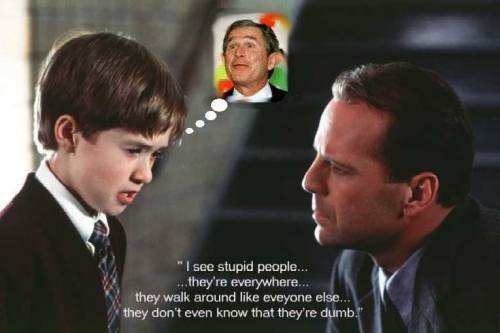
According to Lexus, this is the sort of guy who drives their cars. In fact, I knew him well back in the good old school days. His name is Yorick, Duke of Diddly and Lord of Inanity. He was, literally, a bone head. He'd walk down the hallway at old PS 95 and we'd bet on whether or not he'd trip on his untied shoelaces. But he was a friendly guy. Often he'd walk up to the crowd of us in the hallway outside of Miss Wow's room, where we camped out, and say, "Duh!" or, if he was having a better day, he'd tell us what he thought his name was. A few times he got it right. That was before he was declared legally an idiot. After that, they took him away and made him a cap with bells on it. He was never the same. I don't think he can legally drive, actually. So what do you make of his being a poster—bored for Lexus? I don't know. Maybe, it's justice.

Friday, April 28, 2006

THE LITTLE RED WAGON OF SPOKANE
DOW JONES? WHY?

Allan Sloan of NEWSWEEK says forget the Dow: “The S&P and the Wilshire are much more important, broad based indexes that are keyed to the stock market’s overall value.”

As for me, this blogger, because my company offered a 401k, I dove into the stock market for the first time in my life in my fifties. It’s been okay, but, now every time I do something with my stocks, it costs me hundreds of dollars. These kinds of expenses are okay for millionaires, but they aren’t fair to little investors like me. I’ve not done the necessary work to check and see if CDs are not just as good after I subtract the expenses involved with moving stocks around to invest in newer ventures. I can’t understand why people get to charge me so much to take my money and use it for their own gain. I know that I can go “C” stocks versus “A” stocks and etcetera, but then you have to hold them for longer. Only millionaires can afford to play the stock market if you ask me.

NETROOT? WHAZZAT?

“Netroots are the crazy political junkies who hang out in blogs.” —Markus Moulitsas Zuniga interviewed by NEWSWEEK, Jan. 9, 2006

SCIENCE MARCHES ON. . .

Stem cells embedded in futuristic materials may heal decades-old spinal cord injuries and rescue patients from paralysis, if recent experiments in rodents can be replicated in humans.
Update: You can't go to "Go Here To Read More". The page is gone. So why link to things which will be disappeared? Why not just scan in the whole article and credit it. If people don't want us to use their material verbatim, they should keep their links active for those of us who'd like to link to their home sites and merely reference the original.

UNLESS BUSH WANTS TO SILENCE THE FACTS

“The top climate scientist at NASA says the Bush administration has tried to stop him from speaking out since he gave a lecture last month calling for prompt reductions in emissions of greenhouse gases linked to global warming.

“The scientist, James E. Hansen, longtime director of the agency's Goddard Institute for Space Studies, said in an interview that officials at NASA headquarters had ordered the public affairs staff to review his coming lectures, papers, postings on the Goddard Web site and requests for interviews from journalists.” —From a New York Times article two months ago

Wednesday, April 26, 2006

LOTT OF SNEAKY BUSH WHAT NOT

What Not

A man and his wife are dining at a table in a plush restaurant, and the husband keeps staring at a drunken lady swigging her gin as she sits alone at a nearby table.

The wife asks, "Do you know her?"

Yes," sighs the husband, "She's my ex-wife. She took to drinking right after we divorced seven years ago, and I hear she hasn't been sober since."

My God!" says the wife, "Who would think a person could go on celebrating that long."


Sneaky

I don't trust this Bushman one bit. His goal is to destroy everything that's made the average citizen feel safe growing up in America. We always had something to depend on and Social Security lifted millions of people out of poverty. He's destroyed the mentally ill. Next it's the elderly. The man has no conscience at all. Do you think it has something to do with his being a Christian?

“However you cut it, though, there's no question that one of Bush's biggest new budget initiatives—if not the biggest—is private Social Security accounts. You'd be able to put in 4 percent of your wages covered by Social Security (up to $1,100 a year), starting in 2010. The cost would total $712 billion through 2016, and would be covered by Social Security tax payments. Think about it. Last year Bush stressed Social Security privatization but didn't put the costs in his budget (though they were in last July's midyear budget update). This year, when he didn't mention privatization, it's in the budget. Go figure.

“What do the numbers tell us? That Bush may be serious about his competitiveness initiative, but he's really serious about privatizing Social Security. That's not an applause line. But it sure is the bottom line.” —Allen Sloan, Newsweek (Feb. 20, 2006, p. 18)

Lott-a-nonsense

"We're going to cut meals to $20 a meal. Where are they going to eat? McDonald's?" Sen. Trent Lott, sneering at some reform proposals capping the price of lobbyist-paid lunches.

Monday, April 24, 2006

DEFINITION OF EVOLUTIONARY PSYCHOLOGY &
DISCOVERING A DUMMY (Explains Itself)

Here’s a whole section, ‘Evolutionary Psychology’, from the opening chapter, “Conceptual Foundations of Evolutionary Psychology” of the HANDBOOK OF EVOLUTIONARY PSYCHOLOGY, edited by David Buss.

The brain’s a computer. I wouldn’t dare try to make a synopsis of this particular section. These details are important and will give you a good look at the field of evolutionary psychology. Nearly 2000 words.

[OPEN QUOTE] Evolutionary Psychology

Like cognitive scientists, when evolutionary psychologists refer to the mind, they mean the set of information processing devices, embodied in neural tissue, that is responsible for all conscious and nonconscious mental activity, that generates all behavior, and that regulates the body. Like other psychologists, evolutionary psychologists test hypotheses about the design of these computational devices using methods from, for example, cognitive psychology, social psychology, developmental psychology, experimental economics, cognitive neuroscience, genetics, physiological psychology, and cross-cultural field work.

The primary tool that allows evolutionary psychologists to go beyond traditional psychologists in studying the mind is that they take full advantage in their research of an overlooked reality: The programs comprising the human mind were designed by natural selection to solve the adaptive problems regularly faced by our hunter-gatherer ancestors—problems such as finding a mate, cooperating with others, hunting, gathering, protecting children, navigating, avoiding predators, avoiding exploitation, and so on. Knowing this allows evolutionary psychologists to approach the study of the mind like an engineer. You start by carefully specifying an adaptive information processing problem; then you do a task analysis of that problem. A task analysis consists of identifying what properties a program would have to have to solve that problem well. This approach allows you to generate hypotheses about the structure of the programs that comprise the mind, which can then be tested.

From this point of view, there are precise causal connections that link the four developments discussed earlier into a coherent framework for thinking about human nature and society (Tooby & Cosmides, 1992):

C-1: Each organ in the body evolved to serve a function: The intestines digest, the heart pumps blood, and the liver detoxifies poisons. The brain's evolved function is to extract information from the environment and use that information to generate behavior and regulate physiology. Hence, the brain is not just like a computer. It is a computer—that is, a physical system that was designed to process information (Advance 1). Its programs were designed not by an engineer, but by natural selection, a causal process that retains and discards design features based on how well they solved adaptive problems in past environments (Advance 4).

The fact that the brain processes information is not an accidental side effect of some metabolic process. The brain was designed by natural selection to be a computer. Therefore, if you want to describe its operation in a way that captures its evolved function, you need to think of it as composed of programs that process information. The question then becomes: What programs are to be found in the human brain? What are the reliably developing, species-typical programs that, taken together, comprise the human mind?

C-2: Individual behavior is generated by this evolved computer, in response to information that it extracts from the internal and external environment (including the social environment, Advance 1). To understand an individual's behavior, therefore, you need to know both the information that the person registered and the structure of the programs that generated his or her behavior.

C-3: The programs that comprise the human brain were sculpted over evolutionary time by the ancestral environments and selection pressures experienced by the hunter-gatherers from whom we are descended (Advances 2 and 4). Each evolved program exists because it produced behavior that promoted the survival and reproduction of our ancestors better than alternative programs that arose during human evolutionary history. Evolutionary psychologists emphasize hunter-gatherer life because the evolutionary process is slow—it takes thousands of generations to build a program of any complexity. The industrial revolution—even the agricultural revolution—is too brief a period to have selected for complex new cognitive programs (4).

C-4: Although the behavior our evolved programs generate would, on average, have been adaptive (reproduction promoting) in ancestral environments, there is no guarantee that it will be so now. Modern environments differ importantly from ancestral ones, particularly when it comes to social behavior. We no longer live in small, face-to-face societies, in seminomadic bands of 20 to 100 people, many of whom were close relatives. Yet, our cognitive programs were designed for that social world.

C-5: Perhaps most importantly, natural selection will ensure that the brain is composed of many different programs, many (or all) of which will be specialized for solving their own corresponding adaptive problems. That is, the evolutionary process will not produce a predominantly general-purpose, equipotential, domain-general architecture (Advance 3).

In fact, this is a ubiquitous engineering outcome. The existence of recurrent computational problems leads to functionally specialized application software. For example, the demand for effective word processing and good digital music playback led to different application programs because many of the design features that make a program an effective word processing program are different from those that make a program a good digital music player. Indeed, the greater the number of functionally specialized programs (or subroutines) your computer has installed, the more intelligent your computer is, and the more things it can accomplish. The same is true for organisms. Armed with this insight, we can lay to rest the myth that the more evolved organization the human mind has, the more inflexible its response. Interpreting the emotional expressions of others, seeing beauty, learning language, loving your child—all these enhancements to human mental life are made possible by specialized neural programs built by natural selection.

To survive and reproduce reliably as a hunter-gatherer required the solution of a large and diverse array of adaptive information-processing problems. These ranged from predator vigilance and prey stalking to plant gathering, mate selection, childbirth, parental care, coalition formation, and disease avoidance. Design features that make a program good at choosing nutritious foods, for example, are ill suited for finding a fertile mate or recognizing free riders. Some sets of problems would have required differentiated computational solutions.

The demand for diverse computational designs can be clearly seen when results from evolutionary theory (Advance 4) are combined with data about ancestral environments (Advance 2) to model different ancestral computational problems. The design features necessary for solving one problem are usually markedly different from the features required to construct programs capable of solving another adaptive problem. For example, game theoretic analyses of conditional helping show that programs designed for logical reasoning would be poorly designed for detecting cheaters in social exchange and vice versa; this incommensurability selected for programs that are functionally specialized for reasoning about reciprocity or exchange (Cosmides & Tooby, Chapter 20, this volume).

C-6: Finally, descriptions of the computational architecture of our evolved mechanisms allows a systematic understanding of cultural and social phenomena. The mind is not like a video camera, passively recording the world but imparting no content of its own. Domain-specific programs organize our experiences, create our inferences, inject certain recurrent concepts and motivations into our mental life, give us our passions, and provide cross-culturally universal frames of meaning that allow us to understand the actions and intentions of others. They invite us to think certain kinds of thoughts; they make certain ideas, feelings, and reactions seem reasonable, interesting, and memorable. Consequently, they play a key role in determining which ideas and customs will easily spread from mind to mind and which will not (Boyer, 2001; Sperber, 1994, 1996; Tooby & Cosmides, 1992). That is, they play a crucial role in shaping human culture.

Instincts are often thought of as the opposite of reasoning, decision making, and learning. But the reasoning, decision-making, and learning programs that evolutionary psychologists have been discovering (1) are complexly specialized for solving an adaptive problem, (2) reliably develop in all normal human beings, (3) develop without any conscious effort and in the absence of formal instruction, (4) are applied without any awareness of their underlying logic, and (5) are distinct from more general abilities to process information or behave intelligently. In other words, they have all the hallmarks of what we usually think of as instinct (Pinker, 1994). In fact, we can think of these specialized circuits as instincts: reasoning instincts, decision instincts, motivational instincts, and learning instincts. They make certain kinds of inferences and decisions just as easy, effortless, and natural to us as humans as catching flies is to a frog or burrowing is to a mole.

Consider this example from the work of Simon Baron-Cohen (1995). Like adults, normal 4-year-olds easily and automatically note eye direction in others, and use it to make inferences about the mental states of the gazer. For example, 4 year-olds, like adults, infer that when presented with an array of candy, the gazer wants the particular candy he or she is looking at. Children with autism do not make this inference. Although children with this developmental disorder can compute eye direction correctly, they cannot use that information to infer what someone wants. Normal individuals know, spontaneously and with no mental effort, that the person wants the candy he or she is looking at. This is so obvious to us that it hardly seems to require an inference at all. It is just common sense. But "common sense" is caused: It is produced by cognitive mechanisms. To infer a mental state (wanting) from information about eye direction requires a computation. There is an inference circuit—a reasoning instinct—that produces this inference. When the circuit that does this computation is broken or fails to develop, the inference cannot be made. Those with autism fail this task because they lack this reasoning instinct, even though they often acquire very sophisticated competences of other sorts. If the mind consisted of a domain-general knowledge acquisition system, narrow impairments of this kind would not be possible.

Instincts are invisible to our intuitions, even as they generate them. They are no more accessible to consciousness than our retinal cells and line detectors but are just as important in manufacturing our perceptions of the world. As a species, we have been blind to the existence of these instincts, not because we lack them but precisely because they work so well. Because they process information so effortlessly and automatically, their operation disappears unnoticed into the background. Moreover, these instincts structure our thought and experience so powerfully we mistake their products for features of the external world: Color, beauty, status, friendship, charm—all are computed by the mind and then experienced as if they were objective properties of the objects they are attributed to. These mechanisms limit our sense of behavioral possibility to choices people commonly make, shielding us from seeing how complex and regulated the mechanics of choice is. Indeed, these mechanisms make it difficult to imagine how things could be otherwise. As a result, we take normal behavior for granted: We do not realize that normal behavior needs to be explained at all.

As behavioral scientists, we need corrective lenses to overcome our instinct blindness. The brain is fantastically complex, packed with programs, most of which are currently unknown to science. Theories of adaptive function can serve as corrective lenses for psychologists, allowing us to see computational problems that are invisible to human intuition. When carefully thought out, these functional theories can lead us to look for programs in the brain that no one had previously suspected.
_______________________________________________________

Footnote (4) Unidimensional traits, caused by quantitative genetic variation (e.g., taller, shorter), can be adjusted in less time; see Tooby & Cosmides, 1990b.

Saturday, April 22, 2006

NO RELIGIOUS TEST FOR AMERICAN PRESIDENCY???????????

As I watch even Mr. John McCain and all other potential Republican candidates kowtow to the religious right in America, I know that our Constitution is trembling like a bad high rise in an Osaka earthquake. Our Constitution specifically states that there will be no religious qualification for one to run for the presidency of the United States but that does not stop religious folk from forcing their candidates to conform to a religious test. Any person who requires a candidate and any candidate who seeks to qualify on a religious basis should be disqualified from voting or running for president because they are supposed to swear to protect the Constitution when they reach office, and if they can easily ignore any one of the stipulations in the Constitution, then they are not protecting but destroying it. So even honest John McCain proves himself to be unworthy to hold the office.

COMEDY CENTRAL ON THE INSIDER!

Did anyone see the feature on "The Insider" which showed people being exorcised? What a comic act that was. Where did they get such good actors to put on such a wonderful comedy show? We better hope it was a comedy show because if it was real, then we must fear for America if such gullible and easily suggestible citizens are among us on the religious right. Psychology tells us that some of us are more easily hypnotized and open to suggestion than others, and the folk on that show just went to show us how gullible the religious right is. Do you think that easily believing in god is another sign that the religious are not in touch with reality?

I HAVE A SWEATER WHICH FEATURES THE LOGO "FCUK".

It stands for 'French Connection, "United Kingdom" and is a British Company. The reason I own this sweater (beside that fact that it's 100% wool and extremely stylish) is because certain religious conservatives, ever watchful to protect freedom of speech and capitalism, went to the trouble of forcing Federated Department Stores in America to remove this line of products from its shelves, so I went onto the Internet and ordered one from there. Only a dirty mind would think that fcuk spelled fuck.

Friday, April 21, 2006

WHAT ALL PATRIOTS SHOULD BE DRIVING


REAL PRESIDENTS


One of the books I’m reading is David Brinkley’s Memoir. In 1961 Brinkley and thirteen other newsmen were asked to contribute essays to a small book which would be called The Kennedy Circle. I was struck by what Kennedy had to say about his inability to get out to know what the people were thinking and also, his comments bear on the reason that he wanted a wide variety of input into his thinking. He was no arrogant Bushman who only wants yes-men around him. Kennedy’s attitude stands in sharp contrast to the current holder of the White House. If you’re old enough to remember, don’t you miss the man who held the office so very briefly in the early 1960s? What a come down to this clown who’s in office now:

"One of the problems of any President," he [Kennedy] said, "is that his sources of information are limited. I sit in the White House and what I read in the newspapers and magazines and memoranda and things I see—like you and Huntley—is the sum total of what I hear and learn. So the more people I can see, the wider I can be exposed to different ideas, the more effective I can be as President. So, therefore, it is a mistake to have one person working on one subject because then you don't get any clash of ideas and therefore have no opportunity for choice."

HERE’S ONE MORE BENEFIT OF BUSH’S REGIME

“But at least consumers with health plans get to ration their care themselves. The working poor, on Medicaid, face rationing that's growing more severe. The Center for Studying Health System Change has been studying 12 metro areas since 1995. Its 2005 report concluded that, for the unprivileged, "access to basic care is worsening." Because of cutbacks to Medicaid payments to providers, more docs are shutting their doors to the working poor. State-of-the-art hospitals and clinics are opening in affluent suburbs, not downtown. States are paring their Medicaid rolls—and if you're uninsured, you're less than half as likely as the insured to get any medical care. Brutal cutbacks in services for the mentally ill are adding to homelessness-raising costs for shelters, jails and emergency rooms. Fewer specialists are even serving emergency rooms, let alone offering follow-up care.

We like to tell ourselves that, in America, everyone gets health care if it's really needed. But except for certified emergencies, such as a broken bone, doctors and hospitals may turn you away unless you can pay up front. You don't want to lose your health insurance-even the high-deductible kind. Our lottery system of health care is sicker than you think.”

—Jane Bryant Quinn in Newsweek (Feb 27, 2006) p. 47


Wednesday, April 19, 2006

MY IDYLL

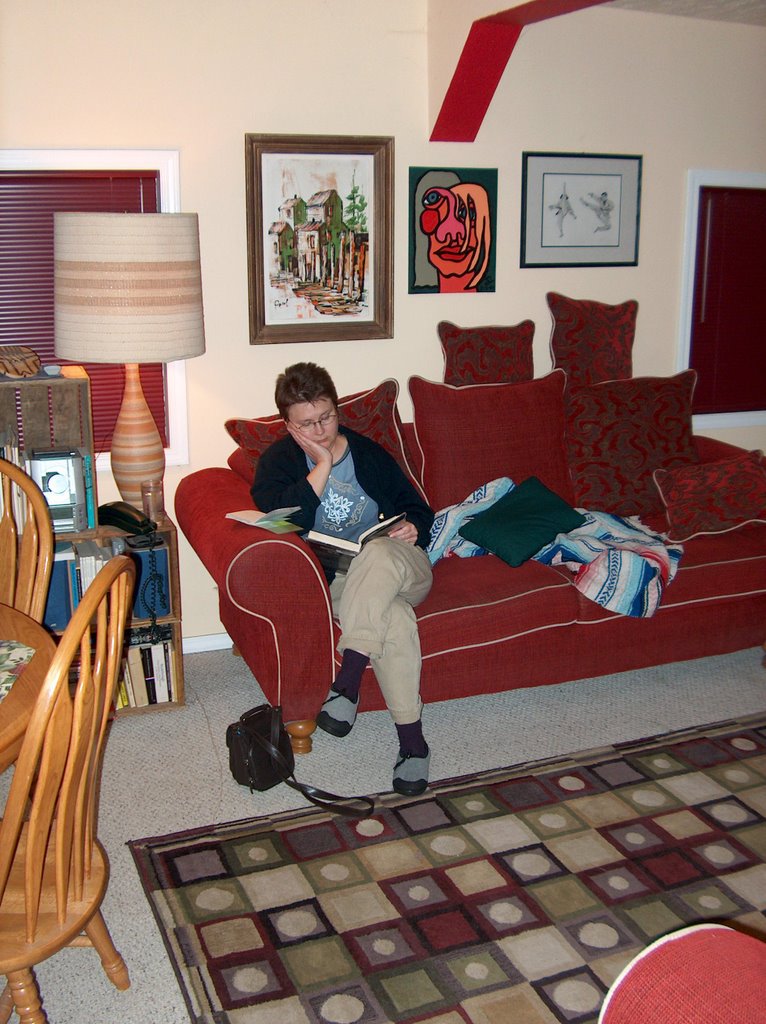
This is the woman, Mertie, who walks side by side with me through life, sitting in our smallish but, I think, stylishly colorful living room with a book which of course she has always ready to hand and some of the art we have bought. The kick boxers on the right are a drawing I made back when I was indulging in some drawing classes at the senior center.
HARDWIRING MORALITY TO THE PENIS or
COMPUTING THE ODDS YOU’LL GET LAID or
BIRTH OF EVOLUTIONARY PSYCHOLOGY from
HANDBOOK OF EVOLUTIONARY PSYCHOLOGY

I hit pay dirt when through interlibrary loan I got hold of this thick, heavy volume, HANDBOOK OF EVOLUTIONARY PSYCHOLOGY, from the University of Idaho. I’ll never finish it in the three weeks I have, But this book is a text full of the details of the exciting new field of “evolutionary psychology”. Here’s where the future of knowledge is which is most important for human progress. It’s edited by David Buss, full of basic essays about the field, and is foreworded by Steven Pinker. At the time of this blog entry, I’ve now bought a copy of the book for myself on Amazon for $75 bucks and, now, as I make this posting, it's gone up to $79.99. This entry's a long one, folks, but it’s fascinating and detailed:

[OPEN QUOTE] For those eager to leap directly from theories of selection pressures to predictions of fitness maximization, there remains a missing level of causation and explanation: the informational or computational level. This level cannot be avoided if the application of Darwin's theory to humans is ever to achieve the necessary level of scientific precision. Natural selection does not operate on behavior per se; it operates on a systematically caused relationship between information and behavior. Running—a behavior—is neither good nor bad. Running away from a lion can promote survival and reproduction; running toward a lion will curtail both. To be adaptive, behavioral regulation needs to be functionally contingent on information; for example,flee when you see a stalking lion. But a systematic relationship between information and a behavioral response cannot occur unless some reliably developing piece of organic machinery causes it. These causal relations between information and behavior are created by neural circuits in the brain, which function as programs that process information. By altering the neural circuitry that develops, mutations can alter the information processing properties of these programs, creating alternative information-behavior relationships. Selection should retain or discard alternative circuit designs from a species' neural architecture on the basis of how well the information-behavior relationships they produce promote the propagation of the genetic bases of their designs. Those circuit designs that promote their own proliferation will be retained and spread, eventually becoming species-typical (or stably frequency-dependent); those that do not will eventually disappear from the population. The idea that the evolutionary causation of behavior would lead to rigid, inflexible behavior is the opposite of the truth: Evolved neural architectures are specifications of richly contingent systems for generating responses to informational inputs.

As a result of selection acting on information-behavior relationships, the human brain is predicted to be densely packed with programs that cause intricate relationships between information and behavior, including functionally specialized learning systems, domain-specialized rules of inference, default preferences that are adjusted by experience, complex decision rules, concepts that organize our experiences and databases of knowledge, and vast databases of acquired information stored in specialized memory systems—remembered episodes from our lives, encyclopedias of plant life and animal behavior, banks of information about other people's proclivities and preferences, and so on. All of these programs and the databases they create can be called on in different combinations to elicit a dazzling variety of behavioral responses. These responses are themselves information, subsequently ingested by the same evolved programs, in endless cycles that produce complex eddies, currents, and even singularities in cultural life. To get a genuine purchase on human behavior and society, researchers need to know the architecture of these evolved programs. Knowing the selection pressures will not be enough. Our behavior is not a direct response to selection pressures or to a "need" to increase our reproduction.

Hence, one of several reasons why evolutionary psychology is distinct from human sociobiology and other similar approaches lies in its rejection of fitness maximization as an explanation for behavior (Cosmides & Tooby, 1987; Daly & Wilson, 1988; Symons, 1987, 1989, 1992; Tooby & Cosmides, 1990a, 1992). The relative degree of fitness promotion under ancestral conditions is simply the design criterion by which alternative mutant designs were sorted in the evolutionary past. (The causal role fitness plays in the present is in glacially changing the relative frequencies of alternative designs with respect to future generations.) Although organisms sometimes appear to be pursuing fitness on behalf of their genes, in reality they are executing the evolved circuit logic built into their neural programs, whether this corresponds to current fitness maximization or not. Organisms are adaptation executers, not fitness pursuers. Mapping the computational architecture of the mechanisms will give a precise theory of behavior, while relying on predictions derived from fitness maximization will give a very impoverished and unreliable set of predictions about behavioral dynamics.

To summarize, evolutionary psychology's focus on psychological mechanisms as evolved programs was motivated by new developments from a series of different fields:

Advance 1: The cognitive revolution was providing, for the first time in human history, a precise language for describing mental mechanisms as programs that process information. Galileo's discovery that mathematics provided a precise language for expressing the mechanical and physical relationships enabled the birth of modern physics. Analogously, cognitive scientists' discovery that computational-informational formalisms provide a precise language for describing the design, properties, regulatory architecture, and operation of psychological mechanisms enables a modern science of mind (and its physical basis). Computational language is not just a convenience for modeling anything with complex dynamics. The brain's evolved function is computational—to use information to adaptively regulate the body and behavior—so computational and informational formalisms are by their nature the most appropriate to capture the functional design of behavior regulation.

Advance 2: Advances in paleoanthropology, hunter-gatherer studies, and primatology were providing data about the adaptive problems our ancestors had to solve to survive and reproduce and the environments in which they did so.

Advance 3: Research in animal behavior, linguistics, and neuropsychology was showing that the mind is not a blank slate, passively recording the world. Organisms come "factory-equipped" with knowledge about the world, which allows them to learn some relationships easily and others only with great effort, if at all. Skinner's hypothesis—that there is one simple learning process governed by reward and punishment—was wrong.

Advance 4: Evolutionary biology was revolutionized by being placed on a more rigorous, formal foundation of replicator dynamics, leading to the derivation of a diversity of powerful selectionist theories, and the analytic tools to recognize and differentiate adaptations, from by-products and stochastically generated evolutionary noise (Williams, 1966). [CLOSE QUOTE]

— David Buss—

Monday, April 17, 2006

AND, NOW, FOR SOMETHING ENTIRELY DIFFERENT: BLACK COLLAR CRIME

If you're lucky enough to be a member of the Freedom From Religion Foundation, you'll receive the kind of news in the 6 times a year newspaper that I'm passing on for your attention below. Crime amongst the clergy is as active as in any other profession, and, if you ask me, sexual crimes are more prevalent within the clergy than without it. That's because of the peculiarly repressive attitude in churches toward sex. Not only that, their code of silence means that children are protected from the sort of information that might save them from predators. Thus predators like church congregations and have an easy time of it in houses of worship and within naive congregations. Not only that—most sexual attacks come from people known to the child. Where else but in friendly, close congregations can predators have such easy access to naive children. There's so much unwarranted trust within congregations.

It's a shame, I suppose, that childish innocence must be shattered, but how else do you protect children from predators? If they see only Disney movies, designed for kids and adults who are still like children, then they'll be vulnerable when confronted with danger, nor will their erstwhile protectors be any more likely to see through a predator's sweetness.

Also remember that the list of crimes below does not count the other lists in the paper such as "convicted and sentenced" and "civil suits settled" and cases under investigation. Not only that, the list below only scratches the surface since it is only people aware of the FFRF publication who will send these in, and that will be such a small percentage of Americans that you can imagine how long these lists would be if everyone contributed local news to this national paper.

Arrested/Charged

• Rev. Eugene Marriott, Fort Washington, MD: raping & beating a woman in Fairfax, VA. The minister for men at Ebenezer African Methodist Episcopal Church was accused of attacking and raping the woman in his car. Her body showed signs of having been hit with a belt & fists. Marriott told police that the attack was a form of role-playing. Sources: United Press InternationaI 3/8/06, wtopnews.com 3/8/06

• Michael Willis Heard, 27, & Gregory Railey Jr., 26, Canton, OH: 4 counts of theft by deception. Heard is founder & chief executive officer of Xzuberant Faith Basketball Association, a Christian-based basketball league. Railey is chief operating officer. The league scammed at least $60,000 from hundreds of people, by promising that nobody would be refused pro contracts as long as they paid registration fees. Sources: The Repository [OH] 3/5/06, 2/11/06

• Rev. Terry Hornbuckle, 44, Arlington, TX: failing to stay in custody long enough to be fitted with an electronic monitoring device. The pastor of the Agape Christian Fellowship Church has been in & out of jail since March last year. He was initially arrested for drug abuse & sexual assault, then arrested three more times for violating the terms of his bail. He was ordered to pay the costs of his twice-weekly drug tests & monthly bond supervision. He cannot consume alcohol or drugs unless prescribed by his doctor & pre-approved by the court. Source: Dallas Morning News 3/3/06

• Rev. Elidio Tapia-Renteria, 45, Owatonna, MN: 4th-degree criminal sexual conduct. The preacher at Calvary Church in Owatonna & Rios De Agua Viva in Faribault was charged with molesting his assistant several times over a 7 month period. He reportedly told the woman she was doing God's work by helping him to liberate himself, & threatened that something bad would happen to her & her family spiritually if she refused. Source: St. Paul Pioneer Press 3/1/06

• Rev. George Silva, 73, Raton, NM: 4 counts of sexual misconduct involving a minor. The Catholic priest was arrested by FBI agents on charges including transporting a boy under age 16 from New Mexico to France & Portugal for criminal sexual activity. He is on administrative leave pending an internal church investigation. Source: Santa Fe New Mexican 2/24/06

• Rev. Morales Saintilus, Long Island, NY: 4 counts of incest, 2 counts of endangering the welfare of a child, & 2 counts of sexual abuse. The pastor & owner of the Ebonizer Baptist Church, attended by Haitian Americans, was charged with raping at least 3 female family members under age 17, some as young as 12. One teen said she was raped nearly twice a week for 4 years. Saintilus is a fire-&-brimstone preacher who often speaks about atoning for one's sins. Source: WABC- TV 2/9/06

• Rev. Kevin Thompson, 48, Bay Area, CA: illegally catching & selling 465 juvenile leopard sharks. The pastor of the Bay Area Family Church & 5 other people were charged with harvesting leopard sharks that were too small for commercial distribution & therefore protected under state law. Source: San Francisco Examiner 2/9/06

• Rev. Vincent Kohn, Springfield, FL: abandonment & cruelty to animals with unnecessary suffering. The pastor of The Anointed Church of God was arrested after a witness saw him throw several puppies into the woods from a pickup truck, leaving them to die. Police who went to Kohn's house found more puppies & their mother, all malnourished and/or with no food or water. Source: local6.com 2/7/06

• Rev. Michael Peters, 36, Denver, CO: 2 counts of sexual assault of a child by a person in a position of trust. The minister at New Hope Baptist Church was charged with sexually assaulting a girl, 17, in 2003. He was then pastor, choir director, & counselor at the 2nd Baptist Church in Boulder. The girl was in the church choir & had come to him for counseling after being a victim of a previous sexual assault. Source: Denver Post 2/7/06, 9news.com 2/7/06

• Rev. Jimmy McCants, 54, Chicago, IL: misdemeanor criminal trespassing. The pastor was arrested in the middle of his sermon at the Zion Evangelical Lutheran Church. The church's board of directors told police they had fired McCants in December, & a woman affiliated with the church had signed a complaint against him for trespassing on church property. Source: AP 2/7/06

• Msgr. Bernard Prince, 71, Ontario, Canada: 2 charges of sexual assault. He was accused of abusing an altar boy, 12, when he was a parish priest in the 1960s. Now retired & living in Rome, he was once secretary general for the Vatican's Pontifical Society for the Propagation of the Faith, & was close to the late Pope John Paul II. Source: AP 2/3/06

• Rev. Charles V. Shifflett, 54, Culpeper, VA: taking indecent liberties with a child. This is the 3rd time he was arrested in just over the same week. The pastor of Calvary Baptist Church, who resigned last November, was charged with an incident occurring in March 1998. He was previously charged with 2 counts of child endangerment in incidents occurring in 1992-93, & taking indecent liberties with a child between 1991-93. He was a leader at Calvary Baptist Academy, a church-run private school. Source: Free Lance-Star 1/27/06

• Timothy Robert Frahm, 40, San Antonio, TX: indecency with a child by contact. The religion, literature, & physical education teacher at Shepherd of the Hills Lutheran Church School was charged with molesting a female student, 12. He has since resigned. Source: San Antonio Express-News 1/26/06

• Rev. Lorenzo Dixon, 40, Arcadia, FL: simple battery & improper exhibition of a firearm. The pastor of Assembly of Praise Church was arrested at the Fairfax Tabernacle Church in Jacksonville for being involved in a fight with another man. During the argument, Dixon wielded a handgun. Source: local6.com 12/28/05

• Rev. Galen Ermil Peckham, 71, Waterloo, IA: indecent exposure, assault with intent to commit sexual abuse, & 2 counts of simple assault. The visiting minister at First United Methodist Church resigned after being arrested for molesting an elderly woman at a care facility. Peckham was also told to refrain from active ministry pending the investigation. Source: Waterloo Cedar-Falls Courier 12/22/05

• Rev. Joseph Briceno, Phoenix, AZ: 8 counts of sex crimes involving 2 minors. The fugitive priest was arrested near the Mexican border. Source: AZ Daily Star 12/17/05

Compiled by Lynn Lau

If you’ve got a clip about ministerial crime send it to:
Attn: Black Collar FFRF, Inc.,
PO Box 750 Madison WI 53701 blackcollar@ffrf.org
Remember to include newspaper & date.

Friday, April 14, 2006

CURRENT READING

It’s very diverse. Woody Allen’s Side Effects, an early collection of his writing, The Two Lives of Errol Flynn. Also David Brinkley’s Memoir and, of course, still plowing through and enjoying the heavy but informative reading in Handbook of Evolutionary Psychology. If anyone’s interested. I believe I’ll be reading the Handbook far into next year—more than a thousand pages of very detailed information.


THE ENTRY TO THE RIGHT IS SELF EXPLANATORY>>>

I got it from the newspaper the Freedom From Religion Foundation publishes. CLICK ON IT TO ENLARGE.